


B2B SEO Services: A Complete Guide to More Leads in 2026
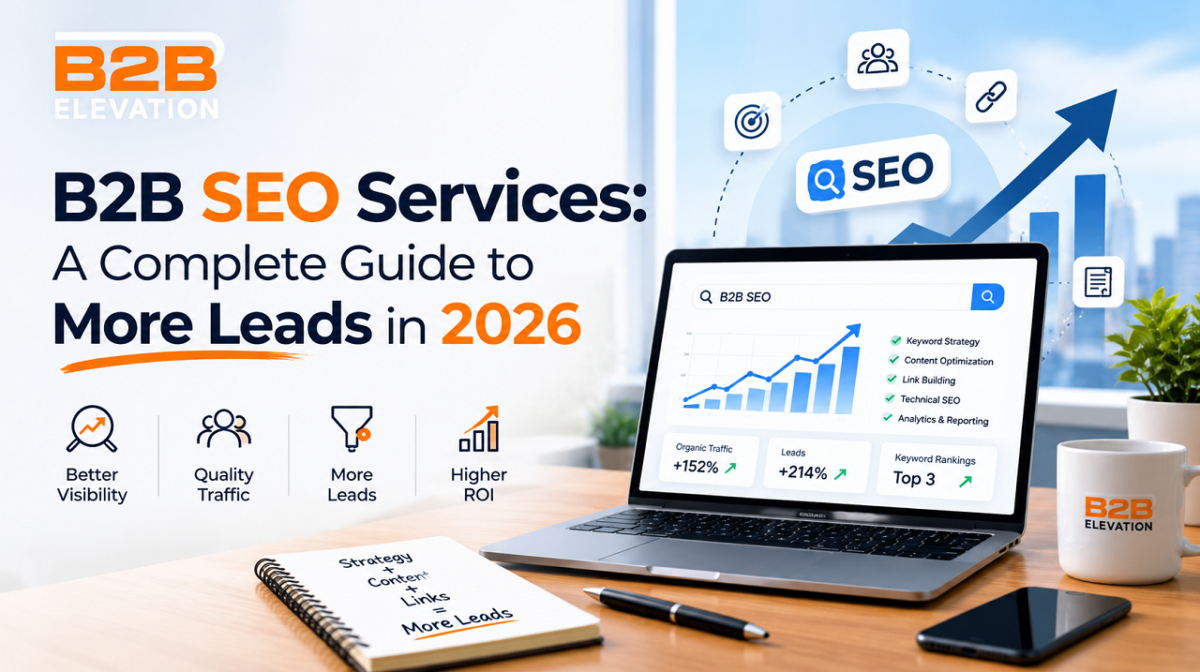
B2B SEO services help businesses improve their visibility in search engines, reach the right buyers, and generate more qualified leads. These services include keyword research, technical SEO, on-page optimization, content writing, and link building. A strong B2B SEO strategy focuses on attracting people who are likely to become customers, not just increasing website traffic.
For B2B companies, getting found online can make a real difference. Business buyers often research problems, compare solutions, and review different providers before making a decision. If your website does not appear when they search, your competitors may get the attention and leads you want.
This guide explains what B2B SEO services include, how they work, what they cost, and how to choose the right SEO partner for your business.
What Are B2B SEO Services?
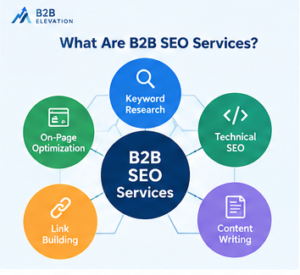
B2B SEO services are search engine optimization services designed for businesses that sell products or services to other businesses.
The goal is to help your website appear for searches made by your ideal customers. These searches may include questions about a problem, software comparisons, service providers, or solutions to a business challenge.
For example, a SaaS company may want to rank for searches such as:
- Best project management software for businesses
- Customer onboarding software
- SaaS SEO agency
- Marketing automation tools for B2B companies
A B2B SEO strategy connects these searches to useful website pages that explain your solution and help buyers take the next step.
Unlike many consumer purchases, B2B buying decisions can involve several people and take weeks or months. Your SEO content should support buyers throughout this process, from learning about a problem to comparing providers.
Why Does Your Business Need B2B SEO Services?
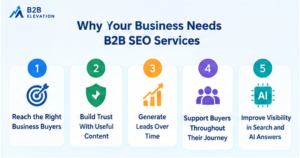
B2B SEO helps potential customers find your business while they are researching products, services, and solutions.
Here are five important benefits.
1. Reach the Right Business Buyers
More website traffic does not always mean more customers. You need visitors who have a real reason to consider your products or services.
Keyword research helps identify the terms your ideal customers use. Your website can then target searches that match their needs, industry, and buying stage.
For example, a SaaS company selling customer support software may gain more useful leads from a relevant software comparison page than from a general article about customer service.
2. Build Trust With Useful Content
Business buyers need clear information before they trust a provider.
Helpful service pages, detailed guides, case studies, and comparison articles can answer their questions and explain how your business solves their problems.
Write Content with accurate information, real examples, and clear explanations. Avoid making claims about results that you cannot prove.
3. Generate Leads Over Time
A well-optimized website can attract potential customers through unpaid search results.
When a relevant page ranks for a useful search, it may bring visitors without requiring you to pay for every click. Results depend on competition, content quality, website health, and other factors.
To turn visitors into leads, give them a clear next step, such as requesting a consultation, booking a demo, or contacting your team.
4. Support Buyers Throughout Their Journey
B2B buyers do not always contact a company after their first search.
Some are learning about a problem. Others are comparing solutions or deciding which provider to choose.
Your content should support each stage:
- Awareness: Explain the problem and possible solutions.
- Consideration: Compare approaches, tools, and services.
- Decision: Explain your services, process, experience, and next steps.
This creates a more useful experience and gives potential customers more reasons to consider your business.
5. Improve Visibility in Search and AI Answers
Business buyers increasingly use search engines and AI tools to research questions, products, and service providers.
SEO, answer engine optimization (AEO), and generative engine optimization (GEO) can support this discovery process.
Clear answers, helpful content, relevant sources, sound technical SEO, and consistent brand information can make your website easier to understand and reference.
However, no agency can guarantee that Google, ChatGPT, Gemini, or another AI system will feature your business in its answers.
What Do B2B SEO Services Include?
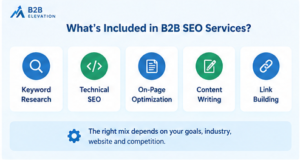
A complete B2B SEO campaign combines several services. The exact plan depends on your website, goals, industry, and competition.
1. B2B Keyword Research
Keyword research identifies the searches your potential customers make and helps you decide which pages to create or improve.
For B2B companies, this means looking beyond search volume. A keyword with fewer searches may attract more valuable leads if it closely matches what your business sells.
Keyword research may cover:
- Commercial keywords related to your services
- Informational searches about customer problems
- Software and service comparison terms
- Industry-specific questions
- Competitor and alternative searches
- Long-tail keywords with clear intent
For example, a SaaS company could target both “what is marketing automation” and “marketing automation software for B2B companies.” The first helps readers learn, while the second may reach buyers comparing solutions.
Each important keyword should be mapped to the most relevant page to prevent several pages from competing for the same search intent.
2. On-Page SEO
On-page SEO improves the content and structure of your website pages so search engines and visitors can understand them.
This service may include:
- Writing clear SEO titles and meta descriptions
- Organizing headings logically
- Improving page content and search intent
- Adding relevant internal links
- Optimizing images and alternative text
- Improving calls to action
- Using suitable structured data where appropriate
For example, a page targeting B2B SEO services should explain what the service includes, who needs it, how the process works, and how to get started.
Adding a keyword repeatedly will not make a weak page valuable. The content must answer the reader’s questions and match the purpose of the search.
3. Technical SEO
Technical SEO helps search engines discover, crawl, understand, and index your website.
Even useful content can struggle to perform when important pages cannot be accessed or indexed properly.
A technical SEO review may check:
- Crawl errors and indexing problems
- Broken links and redirect issues
- Website speed and Core Web Vitals
- Mobile usability
- Duplicate or thin pages
- XML sitemaps and robots.txt
- Canonical tags
- Website structure and internal linking
- Relevant structured data
The priority is to identify problems that affect important pages and fix them in the right order.
4. B2B SEO Content Writing
Content writing creates useful pages and articles around the questions your customers ask.
For SaaS and marketing businesses, this may include service pages, educational guides, software comparisons, use cases, and implementation resources.
Good B2B SEO content should:
- Address a clear search intent
- Explain complex topics in simple language
- Use examples that match the target audience
- Include reliable facts and sources
- Show real experience where possible
- Guide readers toward a relevant next step
Publishing more articles is not always the answer. Improving existing content, filling important topic gaps, and creating pages for high-intent searches may be more useful.
5. Off-Page SEO and Link Building
Off-page SEO helps build your website’s authority and reputation beyond your own pages.
One important part is earning relevant backlinks from other websites. A backlink is a link building process in which we take a link from one website for another website.
Useful approaches include:
- Publishing original research and useful resources
- Earning links through digital PR
- Contributing expert insights to relevant publications
- Building relationships with industry websites
- Creating content that other publishers want to reference
Relevance and editorial quality matter. Buying large numbers of low-quality links or using manipulative link schemes can create risks rather than lasting value.
6. Conversion Rate Optimization
SEO should help your business strengthen digital presence.
Conversion optimization (CRO) improves the chances that relevant visitors will complete an action, such as submitting a form, booking a demo, or requesting a quote.
For B2B websites, this may involve:
- Making service benefits easier to understand
- Improving contact forms
- Adding relevant case studies and testimonials
- Making calls to action more visible
- Removing unnecessary steps from enquiry forms
- Testing different page layouts and messages
For example, a SaaS website may receive organic traffic but few demo requests. Reviewing the page’s message, user experience, and demo process can help identify where visitors lose interest.
7. AEO and GEO Optimization
Answer engine optimization and generative engine optimization focus on making useful information easier for answer engines and generative AI systems to understand and potentially reference.
For B2B SEO companies, this work may include:
- Answering important customer questions directly
- Using clear headings and logical page structure
- Supporting claims with reliable sources
- Maintaining accurate brand and service information
- Publishing detailed, relevant expert content
- Strengthening the website’s overall technical health
- Monitoring available AI visibility and referral data
AEO and GEO should complement strong SEO foundations rather than replace them. There is no guaranteed method for securing citations or recommendations in AI-generated answers.
How Does a B2B SEO Strategy Work?
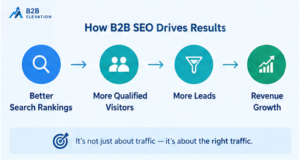
A successful B2B SEO campaign follows a clear process. Each step should support your business goals.
Step 1: Know Your Business and Audience
Start by identifying your products or services, ideal customers, target industries, and main competitors.
Learn what problems your customers face, what solutions they search for, and what makes your business different.
This information helps you build an SEO strategy around real business needs.
Step 2: Audit Your Website
Review your website’s technical health, current rankings, content quality, internal links, and conversion paths.
Check which pages already attract relevant traffic and which important pages have problems.
An audit should produce a prioritized action plan rather than a long list of technical issues without clear next steps.
Step 3: Research Keywords and Competitors
Study the search results for your target keywords. Review competing pages to understand what they cover, how they meet search intent, and where useful information is missing.
Look for opportunities to create more helpful content, improve page structure, answer overlooked questions, or explain your services more clearly.
Do not copy competitors. Use the research to identify what your audience still needs.
Step 4: Optimize Important Pages
Improve your highest-priority service pages and other pages with strong business potential.
Update titles, headings, content, internal links, and calls to action. Fix technical problems that prevent search engines or visitors from using the pages properly.
Step 5: Publish Helpful Content and Build Authority
Create content that supports your services and answers questions at different stages of the buying journey.
Strengthen internal links between related pages and work toward earning relevant backlinks from trustworthy sources.
Every new page should have a clear purpose. Avoid publishing articles only to reach a monthly content target.
Step 6: Measure Results and Improve
Track performance using tools such as Google Search Console and Google Analytics.
Important metrics include:
- Rankings for relevant commercial keywords
- Organic clicks and impressions
- Qualified organic leads
- Contact form submissions and demo requests
- Organic conversion rate
- Sales opportunities influenced by organic search
- Revenue where attribution data is available
Review the data regularly and improve the pages and topics with the greatest potential.
B2B SEO vs. B2C SEO: What Is the Difference?
Both approaches aim to improve search visibility, but their audiences and buying processes can differ.
| Factor | B2B SEO | B2C SEO |
| Target audience | Businesses and professional buyers | Individual consumers |
| Buying process | Often longer and involves several people | Often shorter, depending on the purchase |
| Content focus | Business problems, solutions, comparisons, and ROI | Product benefits, reviews, prices, and buying guides |
| Common conversions | Demo requests, consultations, and sales enquiries | Purchases, bookings, and subscriptions |
| Success measures | Qualified leads, opportunities, and revenue | Sales, transactions, and revenue |
These are common patterns, not fixed rules. Some B2B purchases happen quickly, while some consumer purchases require extensive research.
The best SEO strategy depends on how your particular customers search and make decisions.
How Much Do B2B SEO Services Cost?
The cost of B2B SEO services depends on the amount of work required, competition, website size, content needs, and business goals.
Common pricing models include:
- Monthly retainers: Ongoing SEO strategy, optimization, content, and reporting.
- Project-based SEO: A defined task, such as a technical audit or website migration.
- Hourly consulting: Expert support for specific questions, reviews, or strategy work.
- In-house SEO: Hiring employees to manage SEO within your business.
As an illustrative US-market benchmark, some 2026 guides report monthly retainers starting around $2,000, with many substantial campaigns costing several thousand dollars per month and enterprise programs costing considerably more. Actual prices vary widely, and these figures are not a universal rate card.
Before choosing a provider, ask what the fee covers. Compare the strategy, technical work, content production, link acquisition, reporting, and expected level of support.
A lower price is not always better, and a higher price does not guarantee better results.
How Long Does B2B SEO Take to Show Results?
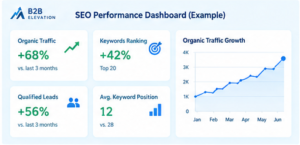
B2B SEO is a long-term process, and results depend on your starting point and the level of competition.
Some websites see early improvements after technical fixes or content updates. Building strong rankings, consistent qualified leads, and measurable revenue impact can take several months or longer.
The timeline may depend on:
- Your website’s current health and authority
- How competitive your target keywords are
- The quality of your existing content
- How quickly recommended changes are implemented
- The strength of your competitors
- Your content and link-building resources
Be cautious of agencies that guarantee a specific ranking or a fixed number of leads within a short period.
A trustworthy provider should explain what it plans to do, how it will measure progress, and which factors could affect results.
How to Choose the Right B2B SEO Services Provider

The right provider should understand your business, your audience, and the way your customers make buying decisions.
Use these questions when comparing agencies.
1. Do They Understand Your Industry?
Ask whether they have experience with your business model, target market, or similar customer problems.
For SaaS and marketing companies, relevant experience can help the team understand software comparisons, commercial search intent, and longer buying journeys.
2. Do They Have Evidence of Their Work?
Look for case studies, examples of optimized pages, or clear explanations of previous projects.
Ask how the provider measured success. Traffic growth alone may not show whether SEO attracted qualified leads.
3. What Services Are Included?
Confirm whether the engagement includes technical SEO, keyword research, on-page optimization, content writing, and off-page SEO.
If AI search visibility is important to you, ask how the provider approaches AEO and GEO and what it can realistically measure.
4. How Do They Report Results?
Reports should explain what changed, what improved, what still needs work, and what the team plans to do next.
Ideally, reporting should connect search performance with enquiries, sales opportunities, and revenue when reliable tracking is available.
5. Is the Strategy Built for Your Business?
Avoid one-size-fits-all plans that promise the same number of articles or backlinks to every client.
Your SEO plan should reflect your goals, resources, competitive position, and highest-value opportunities.
Why Choose B2B Elevation for B2B SEO Services?
B2B Elevation helps businesses improve their online presence through SEO-focused content, on-page optimization, off-page SEO, and web development.
For SaaS and marketing businesses, the right combination of useful content, a technically sound website, and relevant authority signals can support long-term organic growth.
Our approach focuses on the foundations that help your website serve both search engines and real people:
- On-page SEO: Improve page content, headings, internal links, and search intent.
- Off-page SEO: Strengthen website authority through relevant, quality-focused link-building activities.
- Content writing: Create clear, useful content around the questions your target audience searches for.
- Web development: Support website structure, usability, and technical improvements that help visitors navigate your site.
Every business has different needs. The best starting point is to understand your website’s current performance, identify gaps, and prioritize the work that aligns with your goals.
If your SaaS or marketing business wants to improve organic search visibility and attract more relevant visitors, explore B2B Elevation’s SEO services to see how the right strategy can support your growth.
Final Thoughts
B2B SEO services work best when they connect search visibility with real customer needs and business goals. A clear strategy combines technical SEO, useful content, relevant backlinks, and a website that makes it easy for potential customers to take action.
Start by analyzing your audience, improving your most important pages, and measuring the results that matter to your business. Over time, consistent work can help your website earn greater visibility and attract more qualified opportunities.
Frequently Asked Questions
Q.1: What are B2B SEO services?
B2B SEO services help businesses improve their search visibility and attract potential business customers. They can include keyword research, technical SEO, on-page optimization, content writing, link building, and performance reporting.
Q.2: Which SEO services are most important for B2B companies?
The most important services depend on the website’s needs. Keyword research, technical SEO, on-page optimization, useful content, and relevant authority building are common foundations. Conversion improvements help turn qualified visitors into enquiries.
Q.3: Is SEO effective for B2B SaaS companies?
Yes. SEO can help SaaS companies reach people researching software categories, comparing tools, and looking for solutions to specific problems. Results depend on search demand, competition, content quality, and how well the website converts visitors.
Q.4: Can B2B SEO help my business appear in AI search results?
Good SEO practices can support visibility in AI-generated answers, but they do not guarantee inclusion. Clear content, reliable information, relevant sources, and a technically accessible website can improve the chances that search systems understand and reference your business.
Q.5: How much should a B2B company spend on SEO?
There is no single budget that fits every company. Costs depend on competition, website size, goals, and the services required. Ask providers for a clear scope and compare what each package actually includes.
Q.6: How do I measure the success of B2B SEO?
Measure relevant organic traffic, keyword performance, qualified leads, demo requests, sales opportunities, and revenue where possible. Use tools such as Google Search Console and Google Analytics, together with your CRM, to understand performance.