

Google Ads PPC Optimization: How to Improve ROI, Lower CPC & Increase Conversions
If you’ve spent money on Google Ads ever and didn’t get your desired results, then you’re not alone. Many brands jump into pay-per-click advertising thinking it’s as simple as setting up a campaign and watching the leads roll in. But reality is different, without proper PPC optimization, even a large budget can drain without showing expected results.
PPC isn’t just about launching campaigns. It needs continuous testing, decision-making, and adjustments. If you’re not doing it properly, you’re simply spending money without scaling.
When a campaign is optimized correctly, PPC helps you with improved ad visibility, generate consistent conversions, and lower ad spending. Google Ads is the leading advertising platform which delivers strong ROI, but only when campaigns are managed properly.
According to industry data, businesses make an average of $3 for every $1.5 spent on Google Ads, when running campaigns are fully optimized.
In this blog, you’ll learn proven, practical steps to improve your PPC campaign performance. Whether you’re starting out or trying to improve underperforming ads, these PPC optimization strategies will help you achieve better results from your budget.
What Is PPC Optimization?
PPC optimization is the process of improving your paid ad campaigns to get best results without increasing ad spending. It is also closely related to PPC search engine optimization, as both focus on improving ad performance from search-based traffic, attracting the right audience, and maximizing return on every click.
Keyword Research
↓
Create Ads
↓
Target Audience
↓
Landing Page
↓
Conversions
↓
Analyze Data
↓
Optimize
↓
Repeat
PPC is not a one-time setup, it requires continuous monitoring and management. Campaigns need regular updates based on competition, user behaviour, and data.
At its core, PPC optimization is about quality over quantity. Instead of paying for every random click, you focus on reaching an audience who are more likely to convert.
This process includes:
- Improving ad copy
- Refining keywords
- Adjusting bids
- Analyzing performance data
- Testing landing pages
Each small improvement adds up over time. A slight increase in click-through rate or conversion rate can significantly boost your overall ROI.
One of the biggest mistakes is thinking the campaign will perform automatically well after setup. In reality, performance drops without ongoing optimization as trends, audience behaviour, and competitors change.
In simple terms, PPC optimization is like tuning a musical instrument. If you don’t keep adjusting it, the sound becomes off. But when everything is in tune, the results can be consistent, powerful, and scalable.
According to Google Ads best practices, regularly reviewing keywords, bids, and search terms helps advertisers improve campaign efficiency and minimize wasted ad spend over time.
Why PPC Optimization Is Important for ROI
In paid advertising, every click costs money. That means if you’re making a mistake, even a small one, it directly impacts your budget. This is why PPC optimization is necessary, it makes sure you’re not just spending money, but investing it wisely.
ROI is the ultimate goal for every campaign. Without optimization, you might be paying for random clicks that never convert. For example, targeting broad or irrelevant keywords can bring traffic, but they rarely bring customers. The result? Higher cost with little return.
Optimization shifts your focus to high-intent users, people who are actively searching for your product or service. By refining your targeting and improving ad relevance, you increase the chances of turning clicks into conversions. .
Another key factor is cost control. Platforms like Google Ads use a bidding system, if your management is poor that it can lead you to overpaying for clicks. Regular optimization helps you adjust bids based on performance and get more value from your budget.
Competition is another important factor. Advertisers are constantly optimizing their campaigns. Without continuous optimization, your ads can lose rankings, visibility, and costs increase with time.
In simple terms, PPC optimization, and investing in PPC management services, turns advertising from unpredictable spending into a scalable, controlled growth strategy.
According to Google Economic Impact data, businesses can generate significant returns from Google Ads when campaign are properly optimized. Companies that continuously improve targeting, ad relevance, and landing page experience often achieve stronger ROI compared to those running unmanaged campaigns.
Core Elements of a Successful PPC Campaign
A successful PPC campaign isn’t built on a single factor, it is a combination of multiple elements working together seamlessly. If one part is performing poor, it affects overall performance. So, we have to focus on each factor for good results.
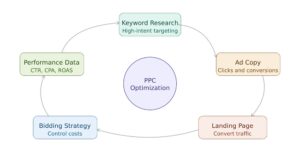
- Keywords are the base of a PPC campaign. They determine when your ads appear and who sees them. Targeting the right keywords makes sure that you reach users with real intent.
- Ad copy drives clicks. A well-written ad speaks directly to the user’s needs and offers a solution. It’s not just about being creative, it is about being relevant and persuasive.
- Landing pages convert traffic into potential customers. Even if your ad is perfect, a poor landing page can ruin everything. The page should match the user’s intent, load quickly, and make it easy for visitors to take action.
- Bidding Strategy controls visibility and your costs. This controls how much you’re willing to pay for each click. The right strategy helps you stay competitive without overspending.
- Performance data ties everything together. Metrics like click-through rate (CTR), cost per acquisition (CPA), and conversion rate provide insights into what’s working and what needs improvement.
When all these elements are aligned, your campaign becomes more profitable, more efficient, and much easier to scale.
Google identifies ad relevance, landing page experience, and expected click-through rate as key factors that influence campaign prformance and Quality Score.
Comparison Table:
| PPC Element | Why It Matters | Optimization Tip |
|---|---|---|
| Keywords | Determines when ads appear | Focus on high-intent and long-tail keywords |
| Ad Copy | Improves CTR | Highlight benefits and include a CTA |
| Landing Page | Increases conversions | Match the landing page with the ad message |
| Bidding Strategy | Controls ad spend | Adjust bids based on performance data |
| Audience Targeting | Reaches the right users | Refine by location, device, and demographics |
How Google Ads Works
Google Ads connects brands with users who are searching for services or products. When someone searches, the platform runs a real-time auction to choose which ads appear.
Google decision is not only based on budget, it also considers:
- Ad relevancy
- Your bidding cost (how much you are willing to pay)
- Overall ad quality
This means advertisers with a small budget can still compete by creating relevant and high-quality ads.
Google Ads offers different type of campaigns, like:
- Search ads > target high intent users
- Video ads > engage users on platforms like Youtube
- Display ads > build awareness across websites
- Shopping ads > promote products directly
| Campaign Type | Best For | Main Goal |
|---|---|---|
| Search | High-intent searches | Leads and sales |
| Display | Brand awareness | Reach new audiences |
| Shopping | Ecommerce | Product sales |
| Video | YouTube marketing | Engagement and awareness |
| Performance Max | Multi-channel advertising | Maximize conversions |
Control is one of Google ads biggest strengths. You can target devices, times, locations, and audiences, making sure that your ads display in front of the right people at the right time.
Real-time performance data allows you to easily adjust campaigns, making PPC a scalable and flexible growth channel.
The Google Ads Auction Explained
The Google Ads auction is the engine that controls the entire platform. Every time a user searches for a product or service, an auction decides which ads appear and in what order.
The ad appearance depends on two key factors:
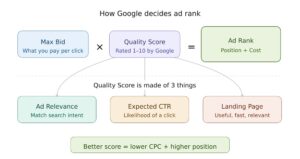
- Quality Score
- Maximum Bid
If your ad quality is good then you can outrank your competitors easily, even if your bid is lower.
That is why optimization matters. Ads that matches user intent and lead to useful landing pages are winning with:
- Lower costs
- Upper positions
Instead of increasing your ad bids, work on ad quality to get better results.
Quality Score and Its Impact on Ad Rank
Quality Score is a rating from (1 to 10) that measures how useful and relevant your ads are. It directly impacts on your cost per click for ads and your ad position.
It is based on three factors:
- Ad relevance
- Expected CTR (click-through rate)
- Useful landing pages experience
A high Quality Score means:
- Better ad placement
- Lower CPC (cost per click)
- Higher ROI
If your Quality Score is low then it does the opposite, forcing you to increase your bid.
Many experienced PPC sepecialists prioritize improving Quality Score before increasing ad budgets. Higher ad relevance and beteer landing page experience often reduce CPC while improving ad visibility, helping advertisers achieve good results without increasing investment.
To improve it:
- Align keywords, ads, and landing pages
- Match with user intent
- Deliver relevant, fast loading landing page experience
Even small improvements can reduce your costs and increase performance.
According to Google, Quality Score is estimated using expected CTR, ad relevance, and landing page experience.
Setting Up a High-Performance PPC Campaign
Before starting optimization, you need a stable campaign structure. During our Google Ads optimization projects, we found that campaigns with tightly themed ad groups consistently achieved higher quality scores and lower CPC than campaigns with mixed keywords.
A high-performance PPC campaign starts with one question: What do you want to achieve exactly? Direct Sales? Brand awareness? More Leads? Without a clear answer in your mind, your targeting becomes vague, your ad copy becomes generic, and your budget gets wasted by clicks that go nowhere.
Define Your Goal First
Your campaign goal determines what you want to achieve, the keywords you choose, the campaign you run, and how you measure success. Set specific KPIs before you run a campaign, not after:
- Conversion rate: are clicks actually turning into customers?
- CPA (Cost per acquisition): how much are you paying per conversion?
- ROAS (return on ad spend): are you getting back more than you invest?
Without these benchmarks, you will have no way of knowing whether you campaign is working or just a waste of money.
Choose the Right Campaign Type
Google Ads offers different campaign types, and picking the wrong is the common and costly mistake that beginners do:
- Display campaigns: ideal for building brand awareness across different websites.
- Search campaigns: best for capturing users with high purchase intent.
- Shopping campaigns: great for eCommerce product listings.
- Video campaigns: good for user engagement and reach on YouTube.
Structure Your Campaigns Properly
Campaign structure is one of the most overlooked factors in PPC. A messy campaign structure makes it nearly impossible to identify what is wrong, or what needs to be fixed.
The rule I follow is very easy: one theme per ad group. If you sell shoes, don’t lump formal shoes, sneakers, and running shoes into the same group. Give each its own space with matched keywords and ads. Yes, it means more ad groups to manage, but your Quality Score improves, your cost per click drops, and your ads get more relevant over time.
Target the Right People, Not Just Anyone
Google Ads gives you the power of targeting controls like location, language, device, time of the day. Use them gently. Showing your ads to users on the wrong device or in the wrong city is a fast way to drain your budget with nothing to show for it.
Refining your location targeting alone can make a noticeable difference in conversion rate, especially for local businesses or region-specific offers.
Allocate Budget Where It Counts
Spreading your budget thin across multiple campaigns is one of the most seen mistakes. It’s tempting to test everything at once, but in practice, a small group of well-targeted keywords usually drives the majority of conversions.
So, start focusing. Identify your highest-value keywords, invest on them, and scale only once the data supports it. A well-structured campaign is always easier to optimize and the results compound over time.
Keyword Research and Targeting
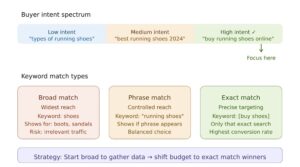
Keywords are the backbone of any PPC campaign. If you are choosing the wrong keywords to target, it doesn’t matter how good your ads are, you will be showing ads to the wrong audience.
Effective keyword research isn’t just about finding popular search items. It is about understanding intent. What is the user actually looking for when they type those words? Are they ready to buy, or just browsing? That distinction alone can make or break your campaign performance.
Google recommends regularly reviewing the Search Terms report to discover new keyword opportunities and identify irrelevant traffic.
Identifying High-Intent Keywords
Not all clicks are equal. Some users are comparing, some are researching, and some are ready to pull out their credit card. Your job is to focus your budget on the last group.
High-intent keywords signal a strong likelihood of conversion. Compare these two searches: “buy running shoes online” versus “types of running shoes.” The first one tells you the user knows what they want and is ready to act. That’s the traffic you want.
Looking for action-oriented phrases in your keyword research:
- “get,” “buy,” “order,” “book”
- “discount,” “best price,” “deal”
- “Near me,” “same day,” “fast delivery”
These aren’t just random keywords, they are buying signals. Targeting them may bring in lease traffic overall, but the traffic you do get get will convert into buyers at a much higher rate,
| Match Type | Reach | Precision | Best Use Case |
|---|---|---|---|
| Broad Match | High | Low | Keyword discovery |
| Phrase Match | Medium | Medium | Balanced targeting |
| Exact Match | Low | High | High-converting keywords |
Using Match Types and Negative Keywords Strategically
Match types and negative keywords are the filters that control when your ads show up. Without using them correctly, your ad campaign will drain the budget on irrelevant searches.
Google Ads offer three match types:
- Broad match: wide reach, but often too loose. Good for discovery, not for low budgets.
- Phrase match: your keyword must appear in the search in order. More visible and controlled.
- Exact match: your ad only shows for that specific search. Most precise, least reach
The smart decision is to use all three in layers, Start with broad match or phrase match to gather data on how people are actually searching. Then shift the budget toward exact matches on your best performers.
In many PPC campaigns, adding negative keywords helps eliminate irrelevant searches and reduce wasted ad spend. For example, advertisers selling premium products often exclude tersm such as “Free” or “Cheap” to attract more qualified traffic.
Creating High-Converting Ads
You can target the audience according to your preference, but if your ad doesn’t grab attention, then users will scroll right past it. Ad copy is where campaigns are won or lost, and most advertisers do not spend enough time on it.
Just think about your own behaviour on Google. WHen you’re presented with multiple options, what makes you click one over the others? Usually, it’s the ad that speaks directly to your concerns, feels trustworthy, and promises a clear benefit.
Writing Compelling Ad Copy
Efficient ad copy is not about being clever. It is about being relevant, clear and persuasive in that order.
Start by putting yourself in your customer’s shoes. What are they looking for? What are they worried about? When your headline directly addresses their concern, your ad immediately feels relevant than the competition.
A list of few concerns that consistently work:
- Use numbers and specifics: “Save 40% Today” outperforms “Big Discounts Available” every time. Specificity builds trust and makes your offer feel real rather than vague.
- Lead with benefits, not the feature: Use “Run Faster, Recover Quicker, Specifically designed for serious runners” instead of “Best Running Shoes with Carbon Fibre Sole” One talks about the product, the other talks about the outcome the customer is actually looking for.
- Add urgency when it’s real: Creates genuine motivation to act like “Only 12 left in stock” or “Offer ends sunday”, but only use urgency if it’s true. False urgency destroys trust fast.
- Make your USP obvious: What makes you different from the other ten advertisers showing up for the same keyword? A money-back guarantee? 24/7 support? Free shipping? Put it in the ad, not buried on your landing page.
Always test at least three or four ad variations at once. Small wording changes, even swapping one word in the headline, can produce meaningful differences in click-through rate over time.
Using Ad Extensions to Improve Performance
Ad extensions are one of the most underused tools in Google Ads. They make your ad more clickable, informative, and larger, without increasing your cost per click.
The most useful extensions are:
- Sitelink extensions: link to specific pages (contact pages, top categories, sale items). Gives users a shortcut to exactly what they are looking for.
- Call extension: lets mobile users tap to call you directly.
- Callout extension: highlight key benefits like “No Setup Fee” or “Free Returns.”
- Structured snippets: list out specific product types, service or features.
Google also factors extension usage into Ad Rank. If your extensions are well-implemented then they don’t just improve click-through rate, they can actually improve your ad position without raising your bid. There is no good reason not to use them.
Landing Page Optimization for PPC Success
Getting users to click your ad is only half the battle. What happens after the click determines whether you earn or just spend it.
Your landing page should deliver exactly what the ad promised, nothing more, nothing less. If your ad says “60% off running shoes” and the user lands on your homepage with no mention of that offer, they will leave within seconds. That’s a wasted click and a damaged trust signal.
Aligning Landing Pages with User Intent
When a user clicks on your ad arrives with expectation in mind. Your landing page must meet the user’s expectation the moment they land, not after they scroll, not after they click through another page.
Practically means:
- If your ad promotes a specific service or product, send users directly to that page, not your homepage.
- If your ad mentions a discount, make that discount the first thing they see on your page.
- Keep the headline on your landing page consistent with your ad copy, it assure users that they are in the right place.
Consistency between ad and landing page also builds trust. Users are skeptical. When the message matches across both touchpoints, it signals that you are a legitimate business that delivers on what it promises.
For example, a local home services business reduced its cost per lead by improving landing page relevance and simplifying its contact form, By aligning the page content with the ad message, the company generated more conversions from the same advertising budget.
Remove every source of friction you get your eye on. Shorten your forms. Minimize the steps of buying. The harder you make it for someone to convert, the more of them you will lose.
Bidding Strategies and Budget Optimization
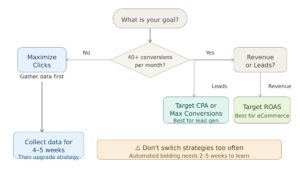
Managing bids and budget efficiently is what keeps your PPC campaigns profitable. If you don’t have a clear strategy, then you overspend on weak keywords easily while underfunding your best performers.
Choosing the Right Bidding Strategy
The right bidding strategy depends on your business goal, and your campaign’s maturity.
If you are just starting out with limited conversion data, Maximize Clicks startegy is the best entry point. It helps you gather traffic and data without requiring a conversion history.
Once you have gathered enough conversion data (typically 40+ conversions/month), Target CPA or Maximize Conversion become far more easy. These automated strategies use Google’s machine learning to adjust bids in real time based on signals you had never been able to monitor manually like location, device, browser, time of day, search history, and more.
Target ROAS is the good choice when your goal is revenue rather than lead volume, mainly useful for eCommerce.
Manual bidding still has a place, basically for small accounts where you want full control or when you are testing a new campaign and don’t want automated strategies making decisions without sufficient data.
One mistake that I can see constantly: switching bidding strategies too frequently. Automated strategies need time to learn, typically two to five weeks. If you change strategy every new day because of not getting results, you are resetting the learning process and never giving it a fair chance.
How to Optimize PPC Campaigns
PPC optimization isn’t something you do one time and revisit it after six months. It’s a weekly process of reviewing what is happening, making small changes, and building on what works.
Here is how to approach it systematically:
- Review your key metrics first: Every optimization session should start with numbers like conversion rate, CTR, CPA, and CPC. If a keyword has a high click volume but zero conversions, something is misaligned. Either the keyword targets the wrong intent, your ad is not relevant, or your landing page is letting you down.
- Manage your keywords actively: Add new high-intent keywords. Stop working on keywords that are spending budget without results. Expand your negative keyword list every few days, there will always be irrelevant searches you haven’t blocked yet.
- Test your ad copy continuously: Don’t settle on one version of an ad and leave it running indefinitely. Always test at least two variations, compare their performance after enough data has accumulated, keep the winner, and replace the losing ad with the new one.
- Adjust bids based on performance: Increase bids on keywords that are actively performing well, converting at a profitable CPA. Lower bids or pausing the ads on those that are not performing and generating results. Bid adjustment for location, device, and time of day can also make a real difference. If mobile users convert at half the rate of desktop users, reduce your mobile bid adjustment accordingly.
- Audit your landing pages on a daily basis: Ad performance and landing page performance are linked. A drop in conversion rate doesn’t always mean the ad is the problem, sometimes the landing page loading speed is slow, or a promotion has expired, or a form is broken.
The campaigns that produce the best results are the ones that get consistent attention. Regular improvements counts, a 6% improvement in conversion rate and a 6% improvement in CTR together can meaningfully change your overall ROI.
Advanced PPC Optimization Techniques
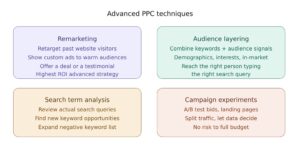
Once your campaigns are stable and consistently generating data, these advanced PPC optimization strategies are where the real performance gains happen.
Remarking is the best advance strategy with highest-ROI. Users who already have visited your website are very familiar with your brand, they are far more likely to convert than cold traffic. Set up remarking audiences for people who visited key pages but didn’t convert, and serve them customized ads that address the reason behind their hesitation. Provide them a testimonial, a limited-time offer, or simply a reminder of what they were looking at.
Audience Layering takes your targeting to another level. Instead of only targeting based on keywords, you add audience signals like interest, demographics, in-market segments, or custom audiences based on your own customer data. This means your ads reach not just the right search terms, but to the right people typing those search terms
Search term analysis is a habit that most advertisers neglect after a few weeks of running the ad. Review your actual search terms report regularly, not only your keyword list. Real searches often reveal new keyword opportunities, patterns, and irrelevant traffic you need to exclude. It is one of the most valuable and underused reports in Google Ads.
Campaign experiments let you A/B test changes like bidding strategies or landing pages without risking your entire budget. Instead of switching something wholesale and hoping for the best, you split traffic between the original and the variant, then let the data decide.
Conclusion
PPC optimization is not a one-time task, it has to be done consistently. The businesses that get consistent, profitable results from Google Ads are not the ones with the biggest budgets. They are the ones who treat their campaigns as something that requires honest analysis, regular attention, and a willingness to test and learn.
Every element we’ve covered like keywords targeting, campaign structure, landing pages, ad copy, bidding, advanced techniques, connects to the others. Work on one, and the other benefits. Neglect one, and the whole system leaks.
Start with the basics, build clean habits around weekly optimization, and add advanced techniques as your data matures. The results don’t come overnight, but they do come after consistent work, and they compound.
FAQs
Q.1: What is a good CTR for Google Ads?
Ans: A good Click-Through Rate (CTR) for Google Ads search campaigns mainly ranges between 3% to 5%. However, it varies by industries, competition, and keyword intent. Higher CTR indicates strong ad relevance and targeting.
Q.2: How can I lower my Google Ads CPC?
Ans: You can lower CPC by improving Quality Score, refining audience targeting, using long-tail keywords, and writing highly relevant ad copy. Removing underperforming keywords and improving landing pages also helps reduce overall costs.
Q.3: Does Quality Score affect ad rank?
Ans: Yes, Quality Score directly impacts Ad Rank. It is based on expected CTR, landing page experience, and ad relevance. A higher Quality Score can improve your ad position while reducing cost per click.
Q.4: What is the difference between PPC optimization and SEO?
Ans: PPC optimization focuses on improving paid advertising performance for immediate traffic and conversions, while SEO focuses on organic rankings for long-term visibility. PPC delivers quick results, whereas SEO builds sustainable long-term growth.
Q.5: What is the best bidding strategy for beginners?
Ans: Start with Maximize Clicks strategy to build traffic and gather data. Once you have 40 or more conversions per month, move to Maximize Conversion or Target CPA, these automated strategies perform significantly well with sufficient data behind them.