


Best Email Delivery Platforms for High Volume Sending [2026]

I used to think picking an email provider was a one-time decision. Set it up, connect the API, move on. That worked fine until our product started sending real volume, and I started watching emails disappear. Password resets going to spam, onboarding sequences not landing, and support tickets piling up with “I never got the email.”
The problem wasn’t the emails, but infrastructure. At low volume, most providers look the same. At high volume, the gaps become impossible to ignore. Deliverability, analytics, IP reputation management, and cost all behave very differently depending on which platform you’re running on.
After working through several options hands-on, I narrowed the best email delivery platforms for high volume sending in 2026 down to four: Mailtrap, Mailgun, Amazon SES, and Postmark. This guide breaks down each one so you can make the right call without spending weeks testing them yourself.
Quick comparison table of high volume sending platforms
| Provider | Best For | Free Plan | Pricing Starts From | Integrations |
| Mailtrap | High email deliverability with industry-best analytics | 4,000 emails/month | $15/month (10K emails) | Node.js, Ruby, PHP, Python, Elixir SDKs + SMTP |
| SendGrid | Enterprises needing transactional + marketing in one platform | 60-day free trial; 100 emails/day |
$19.95month (50K+ emails) | Multiple SDKs + extensive integrations |
| Amazon SES | AWS-native apps prioritizing cost at scale | 3,000 emails/month (from EC2) | $0.10 per 1,000 emails | AWS SDKs + SMTP |
| Postmark | Transactional emails with seamless inbound handling | Free trial only | $15/month (10K emails) | Multiple libraries + SMTP |
How to choose the right email delivery platform for high email sending
The right pick depends on your infrastructure, team size, and how much setup work you’re willing to take on.
- Choose Mailtrap when deliverability and analytics are your top priorities and you want a managed platform that scales without internal DevOps overhead.
- Choose Mailgun when you need granular API control, per-domain routing, or email validation built directly into your sending stack.
- Choose Amazon SES when per-email cost is your main constraint and your team has the AWS expertise to manage configuration and deliverability independently.
- Choose Postmark when delivery speed is non-negotiable and you’re running time-sensitive flows like magic-link authentication or two-factor codes.
1. Mailtrap
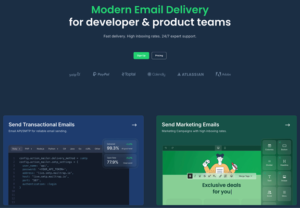
Mailtrap is a high-volume email sending platform built for developers and product teams who need high inbox rates without managing the underlying infrastructure themselves. The feature that earns the most attention is stream separation: transactional and bulk emails run on isolated sending infrastructure by default. That means a marketing campaign that triggers spam complaints cannot damage the reputation handling your password resets. The separation is infrastructure-level, not a configuration workaround.
Setup takes about 5 minutes from account creation to first send. Drill-down reports break out delivery, opens, clicks, bounces, and spam complaints by mailbox provider, domain, and stream. If your password resets stop landing in Gmail, you’ll see it on the dashboard before support tickets start coming in. DKIM keys rotate automatically every month, which matters because most teams configure DKIM once and never revisit it. Dedicated IPs on the Business plan include automatic warmup, so there’s no manual ramp schedule to manage.
Key Features:
- Separate sending streams for transactional and bulk emails
- SMTP relay, Email API, and official SDKs (Node.js, Ruby, PHP, Python, Elixir, Java)
- 25+ framework snippets for Laravel, Symfony, Django, Rails, and Next.js
- Drill-down analytics by mailbox provider, domain, and stream
- 30-day email logs
- Dedicated IPs with automatic warmup
- Deliverability alerts and suppression management
- Webhooks with 40 retries over 5 minutes
- ISO 27001, SOC 2 Type II, GDPR certified
Pricing:
| Plan | Price | Emails/month |
| Free | $0 | 4,000 |
| Basic | $15 | 10,000 |
| Business | $85 | 100,000 |
| Enterprise | $750 | Up to 1.5M |
Best For: Developer and product teams that need high deliverability, detailed analytics, and a platform that handles IP reputation management without internal infrastructure work.
Pros:
- Analytics included on all paid plans, no add-ons required
- Automatic DKIM rotation and IP warmup on Business plans
- MCP, AI skills, AI onboarding
Cons:
- 24/7 live support gated to Business and Enterprise plans
- No advance marketing features
2. Mailgun
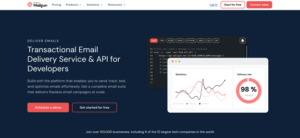
Mailgun is a high-volume email sending platform built API-first, for engineering teams that need precise control over how their sending infrastructure behaves. Per-domain API keys let you isolate traffic per customer or product line, so a deliverability issue in one tenant doesn’t bleed into another. The email validation API checks addresses against DNS/MX records, disposable domain lists, and syntax rules before the send happens. That catches bad addresses at signup rather than after they generate hard bounces.
Batch sends support up to 1,000 recipients per API call with per-address recipient variables. Advanced inbound routing lets you apply regex-based rules to incoming mail. Webhooks retry for 8 hours on failure. The Optimize inbox placement suite is available as a paid add-on for teams that want additional deliverability tooling. Event log retention is 5 days on the base plan, which is the shortest window among the four providers here; Scale plans extend it to 30 days. The infrastructure runs on Google Cloud with a 99.99% uptime SLA on Scale plans.
Key Features:
- RESTful API and SMTP relay
- Official SDKs (Go, Node.js, PHP, Java, Ruby, Python)
- Per-domain API keys for granular access control
- Built-in email validation API
- Batch sends up to 1,000 recipients with per-address recipient variables
- Advanced inbound routing with regex-based rules
- Real-time event logs and webhooks (8-hour retry window)
- SOC 2, ISO 27001, HIPAA, GDPR certified
Pricing:
| Plan | Price | Emails/month |
| Free | $0 | 100/day |
| Basic | $15 | 10,000 |
| Foundation | $35 | 50,000 |
| Scale | $90 | 100,000 |
Best For: Developer-heavy engineering teams building complex inbound and outbound workflows.
Pros:
- Email validation API reduces hard bounces before they happen
- Per-domain API keys for multi-tenant architectures
- Inbound routing with regex-based rules
Cons:
- 5-day event log retention on the base plan
- Optimize analytics suite is a separate paid add-on
- No official CLI or native agent tools
3. Amazon SES
Amazon SES is a high-volume email sending platform built as raw infrastructure, and that’s entirely intentional. It delivers the lowest per-email cost in this comparison at $0.10 per 1,000 emails. Teams already on AWS get native hooks into Lambda, S3, CloudWatch, SNS, and EventBridge, which makes SES the logical fit for anyone who wants email delivery without adding a new vendor relationship. HIPAA-eligible and FedRAMP compliant, it also satisfies regulated-industry procurement requirements that the other providers here cannot.
What SES doesn’t provide out of the box is everything else. Bounce suppression, native webhooks, analytics, and stream separation all need to be assembled manually. Bounce and complaint events fire as SNS notifications, and suppression logic sits on top of the account-level suppression list. Advanced deliverability analytics are available through the Virtual Deliverability Manager, but that’s a separate paid add-on. New accounts start in sandbox mode and can only send to verified addresses until production access is approved by AWS.
Key Features:
- SMTP interface and RESTful API
- AWS SDK support (JavaScript, Python, Java, Go, Ruby, PHP, .NET, Rust, C++, Kotlin)
- Native integrations with Lambda, S3, CloudWatch, SNS, EventBridge
- SPF, Easy DKIM, and DMARC authentication
- Manual IP pool configuration for stream separation
- Dedicated IPs available as optional add-ons
- SOC 2, ISO 27001, FedRAMP, HIPAA-eligible, GDPR compliant
Pricing: Amazon SES costs $0.10 per 1,000 emails with no monthly minimum.
This makes SES the lowest-cost provider in this comparison. The trade-off is that teams may need to spend more engineering time on deliverability, suppression logic, monitoring, and analytics.
Best For: AWS-native engineering teams with in-house DevOps capacity who want the lowest per-email cost and are comfortable building analytics, bounce handling, and stream separation themselves.
Pros:
- Lowest per-email cost in the comparison by a significant margin
- Native AWS integrations for teams already on that stack
- HIPAA-eligible and FedRAMP compliant for regulated industries
Cons:
- No native bounce suppression, webhooks, or analytics out of the box
- Sandbox mode restricts new accounts; production access requires AWS approval
- Meaningful support requires a paid AWS support plan
4. Postmark
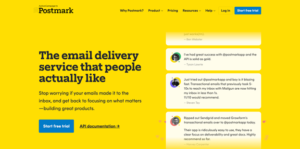
Postmark is an email sending platform optimized for getting high-volume sends to the inbox fast. Sub-second delivery latency is an operational advantage for time-sensitive flows where every second of delay increases drop-off or support load. Before any account goes live, Postmark runs a manual review. It adds a business day to the setup timeline, but it also keeps the shared IP pool clean, which is part of why delivery performance holds up under shared sending conditions.
Like Mailtrap, Postmark has separate streams for transactional and bulk emails. Each stream carries its own IP reputation, so a broadcast campaign with poor engagement cannot touch the delivery of your auth or billing emails. Every bounce is automatically categorized and suppressed with no manual list hygiene required. Activity logs are retained for 45 days, longer than any other provider in this comparison. The cost structure is competitive up to around 50K emails per month, but climbs steeply beyond that. Dedicated IPs are only available for accounts sending 300K or more emails per month.
Key Features:
- Email API and SMTP relay
- Message Streams for transactional, broadcast, and inbound email separation
- 45-day email log retention
- Automatic bounce categorization and suppression
- Webhooks covering delivery, bounce, open, click, and spam complaints
- Official SDKs (Node.js, PHP, Python, Ruby, .NET, Java, Go)
- SPF, DKIM, DMARC authentication
- SOC 2 Type II, GDPR compliant
Pricing:
| Plan | Price | Emails/month |
| Basic | $15 | 10,000 |
| Growth | $60.50 | 50,000 |
| High Volume | $138 | 125,000 |
| Dedicated IP | +$50/month | 300K+ sends required |
Best For: SaaS products where delivery speed directly affects conversion rates or retention. Magic-link logins, two-factor authentication codes, trial confirmation emails.
Pros:
- Sub-second delivery latency for time-sensitive sends
- 45-day log retention, the longest in this comparison
- Automatic bounce suppression with no manual list hygiene
Cons:
- No permanent free tier
- Dedicated IPs locked to accounts sending 300K+ emails per month
- Cost scales steeply past 50K emails per month
Important features to look for in a high-volume email platform
Once you’re sending real volume, a few capabilities go from nice-to-have to load-bearing.
Stream separation. Transactional and bulk emails should run on separate infrastructure. If a marketing send triggers spam complaints, it shouldn’t touch the IP reputation handling your auth flows. Mailtrap and Postmark both do this by default. SES requires manual IP pool configuration to achieve the same result.
Deliverability analytics. Logs tell you what happened. Analytics tell you why. Look for per-provider reporting, bounce categorization, and spam complaint tracking on the base plan. Mailtrap includes this on all paid plans. Mailgun’s Optimize suite and Amazon SES’s Virtual Deliverability Manager are both separate paid add-ons.
IP warmup and management. Dedicated IPs and automatic warmup prevent you from inheriting reputation problems from shared pools. At high volume this becomes critical. Mailtrap includes automatic warmup on Business and Enterprise plans. Postmark gates dedicated IPs to accounts sending 300K or more per month.
Log retention. When something breaks, you need enough history to diagnose it. Postmark retains logs for 45 days. Mailtrap retains 30 days. Mailgun’s base plan lasts only 5 days.
Pricing at actual volume. The per-email cost picture changes significantly as you scale. SES is cheapest per email but requires engineering time to build what managed platforms provide out of the box. Factor in setup time and ongoing maintenance, not just the monthly bill.
Conclusion
The best email delivery platforms for high volume sending each solve a different version of the same problem. Mailtrap is the strongest overall pick for teams that need managed deliverability and full analytics without the infrastructure work. Mailgun fits teams that want fine-grained API control and routing. Amazon SES is the right call when per-email cost is the priority and your team has AWS expertise. Postmark is worth the premium when delivery speed directly affects your product’s user experience.
The right choice comes down to where your actual bottleneck is. Test against your real volume and real flows before committing, and make sure SPF, DKIM, and DMARC are configured before your first production send. Sender reputation is much easier to build than it is to recover once it takes a hit.